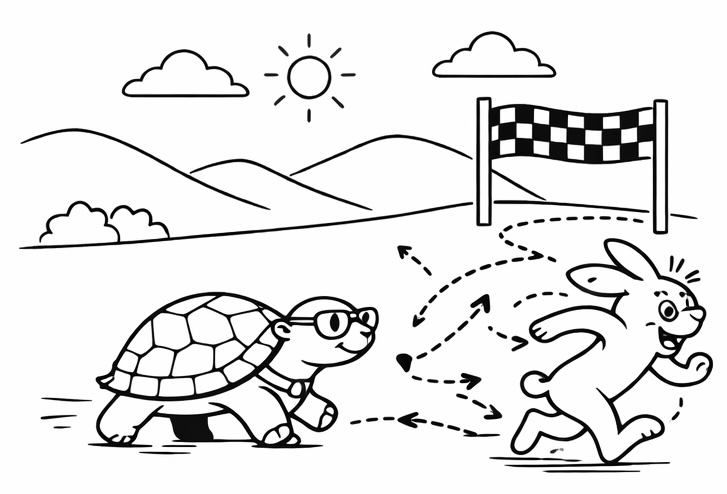
Around 600 BCE, Aesop told a story. A hare mocks a tortoise for being slow. The tortoise, unbothered, challenges him to a race. The hare sprints ahead—so far ahead it’s not even close. Confident in his lead, he stops to nap. The tortoise never stops. One foot in front of the other, steady and deliberate, he crosses the finish line while the hare sleeps. The hare wakes up and sprints, but it’s too late.
The common reading is “slow and steady wins the race.” That undersells it. The tortoise doesn’t win because he’s slow. He wins because he never leaves the course. He knows where the finish line is, and he walks toward it without distraction, without detour, without hesitation. The hare is faster in every measurable way—and still loses. Not because of his speed, but because of what his speed made him believe: that the race was already won.
I’ve been thinking about this story a lot lately.
AI code generation has collapsed the cost of building software. Agents have compressed it further—parallelizing work that used to take teams and weeks. Everyone can build fast now. And when everyone can build fast, your gut says sprint. Move. Ship. Or be left behind.
That’s the hare talking.
When building is no longer the bottleneck, building is no longer the differentiator. Velocity, throughput, cycle time—the things we’ve obsessed over for decades—are being commoditized in real time. The moat many of us have relied on is evaporating.
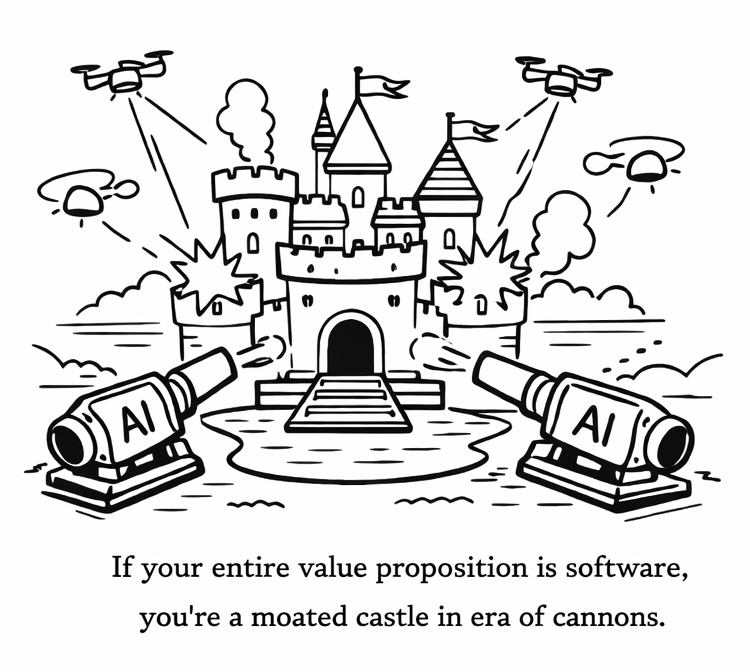
And here’s the part most people aren’t saying out loud: if your entire value proposition is software, you’re a moated castle in the era of cannons. The moat used to hold. But cannons don’t need to cross the moat—they fly right over it. AI doesn’t need to rebuild what you built. It just needs to render it unremarkable.
The companies that endure will solve problems across the full value chain—hardware, services, relationships, domain expertise, distribution. The stuff that can’t be generated by a prompt. Software becomes a piece of the solution, not the solution itself. The tortoise understands the whole course, not just the next stretch of open road.
Here’s another thing about the fable people miss. The hare will run any race. Speed is his identity, so every race looks winnable. The tortoise is different. He’s slow, and he knows it. So he has to be smart about which race he enters. He only runs the one he can win.
In a world where everyone is fast, the most important decision isn’t how to run. It’s which race to run.
Knowing what to build. Knowing who to build it for. Knowing when. And being right. Not a single killer feature—relentless focus on opportunities to solve real problems and create real value, then assembling everything it takes to deliver. Not just the code. The right product, at the right time, for the right customer. That’s the race worth running.
This is where the hare gets himself in trouble. He’ll run any race, so he runs them all. He sees cheap, fast development and thinks I can build everything. I’ll be first. He sprints off in six directions, ships a mediocre v1, pivots, ships again. He’s fast. He’s also lost. And every sprint adds features, surfaces, complexity—not because customers need them, but because he can. When building is cheap, the hare builds for the sake of building. He mistakes motion for progress and volume for value. The codebase grows. The product doesn’t.
The tortoise has restraint. He builds only what creates value and leaves everything else on the table. Where the hare compounds complexity, the tortoise compounds clarity—reducing, focusing, simplifying until the product does one thing so well it’s hard to leave. He doesn’t need a head start. He needs the right heading. And when development is fast for everyone, the tortoise doesn’t fall behind—he just never wanders off the path.
To be fair to the hare—speed still matters. Iteration is cheaper than ever. The tortoise isn’t standing still doing research in perpetuity. He’s walking. Every step is forward progress. But there’s a difference between iteration with direction and iteration without it. One is learning. The other is flailing with a faster stride.
First mover advantage is dead. It was already on life support—most iconic companies weren’t first to market, they were first to get it right. The speed of AI development is the final nail. When your competitor can close the gap fast, being first means nothing. Being first and wrong means you’ve run ahead into a wall.
Pick your race. Every step counts.